I conduct UX research in various forms, including product research to generate ideas (case study #1) and site evaluations (case studies #2 and #3).
- Study 1: user-centred product research
- Study 2: an evaluation of the Collège Jacques-Prévert website
- Study 3: an evaluation of the Chamber of Commerce of Metropolitan Montreal website
Study 1: user-centred product research
An assignment in the UX Design class at my Master’s programme was Project DH – a fictional project to design a new holistic dental care product. The fictional client was Docter & Gambit which is an established dental care company.

Haresh is a persona I created for this. He was modelled after traits based on myself, an interview with a friend who self-describes as an environmentalist, and general trends of a young professional.
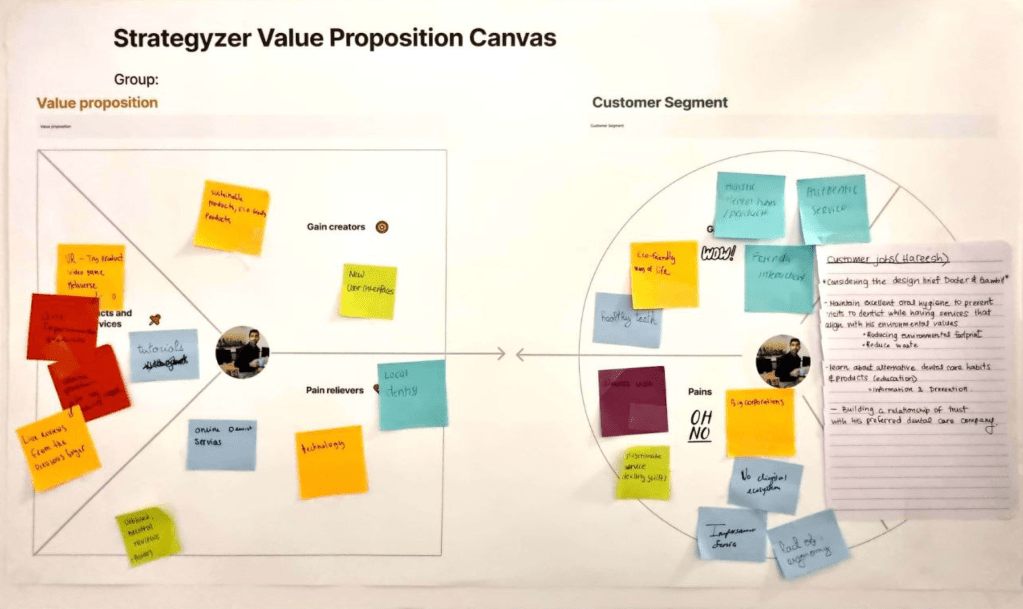

Based on the persona, I facilitated a design thinking workshop with a few undergraduate students at HEC Montréal to generate some ideas for the holistic dental care product. Two brainstorming methods were used: the value proposition canvas and the Power of 10.
The former helps align a product with customer needs by mapping out customer jobs, pains, and gains alongside product features, pain relievers, and gain creators. The Power of 10 attempts to generate ideas by exploring the persona in a variety of contexts, though we did not do 10 ideas here due to time constraints.
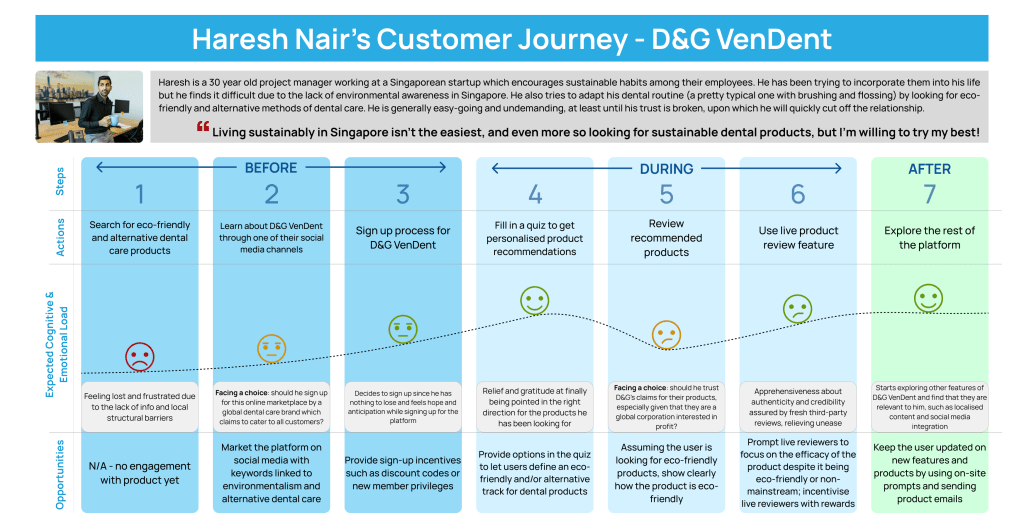

The concept of a one-stop dental health marketplace and content platform was created: D&G VenDent. I used a customer journey map to visualise the steps Haresh could take when interacting with it, highlighting his actions, thoughts, and emotions at each stage to identify pain points and opportunities for improvement.
As part of the Advanced UX Evaluation class, I had the opportunity to work with some Montréal-based institutions and help evaluate their websites for areas of improvement. To challenge myself, I also took the class in French, hence the slides below being in French.
Study 2: an evaluation of the Collège Jacques-Prévert website
The client for this evaluation project was Collège Jacques-Prévert, a private non-profit francophone pre-school and primary school in the Cartierville neighbourhood of Montréal.

We were asked to conduct a general evaluation of the website. We focused on the information search process based on the usability metrics of efficacy and satisfaction.
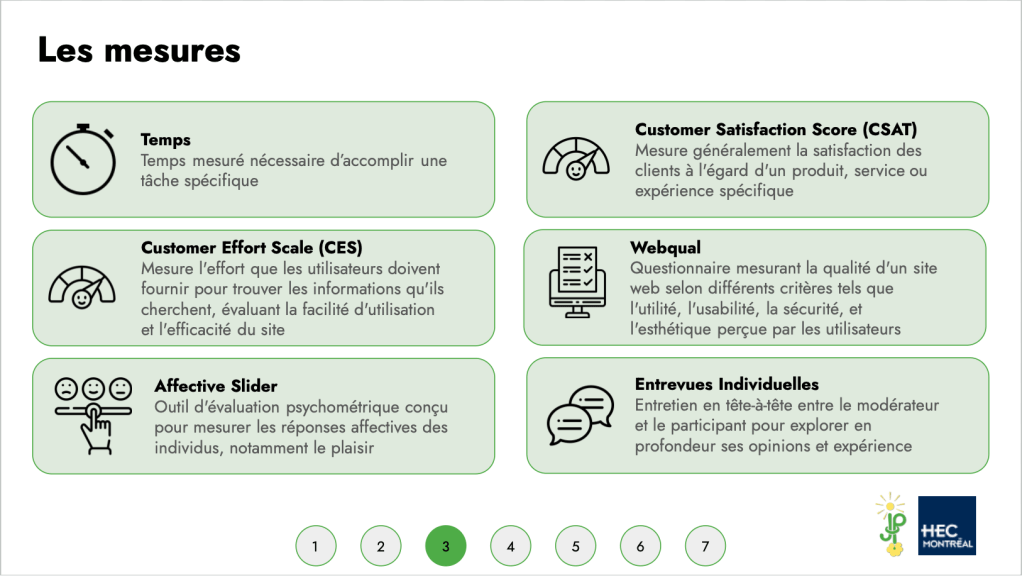
We collected quantitative data using various scales to measure task completion times, satisfaction, effort, web quality, and pleasure. We also conducted post-test interviews for qualitative data to get a fuller picture from participants.
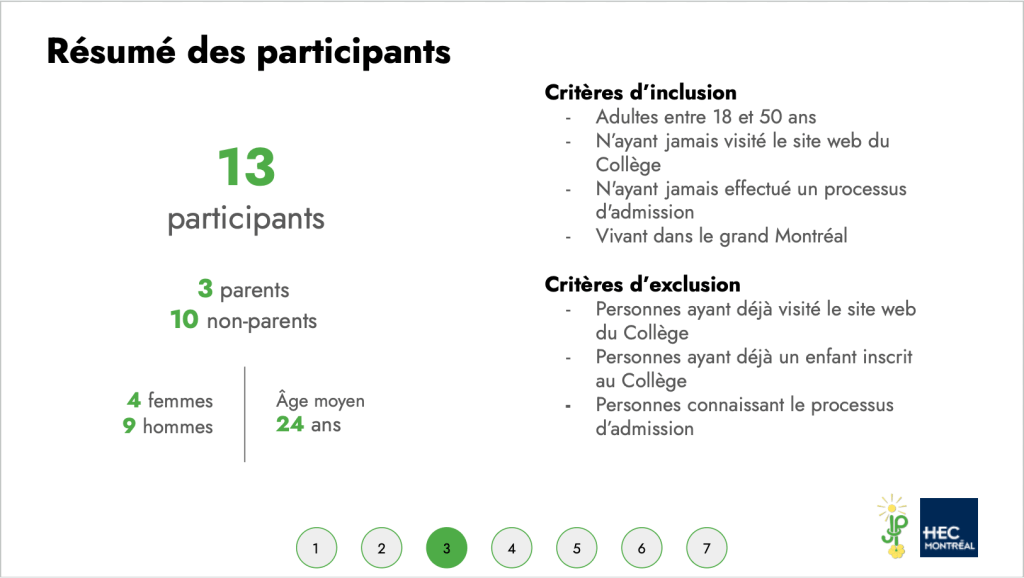
Due to limited resources, we had to do a convenience sample and got participants from people we know. For the scale and length of the project, we had 13 participants, making sure that they have never visited the site and have also never admitted a child to school. This was to replicate the audience of parents admitting their children to a preschool for the first time.

To present our recommendations (redacted for privacy), we conceptualised a traffic light thermometer to indicate the urgency of the recommendation, along with how the recommendation can be implemented.
Study 3: an evaluation of the Chamber of Commerce of Metropolitan Montreal website
The Chamber of Commerce of Metropolitan Montreal (CCMM) is a non-profit organisation promotes economic development and supports the growth of companies in the Greater Montreal area.
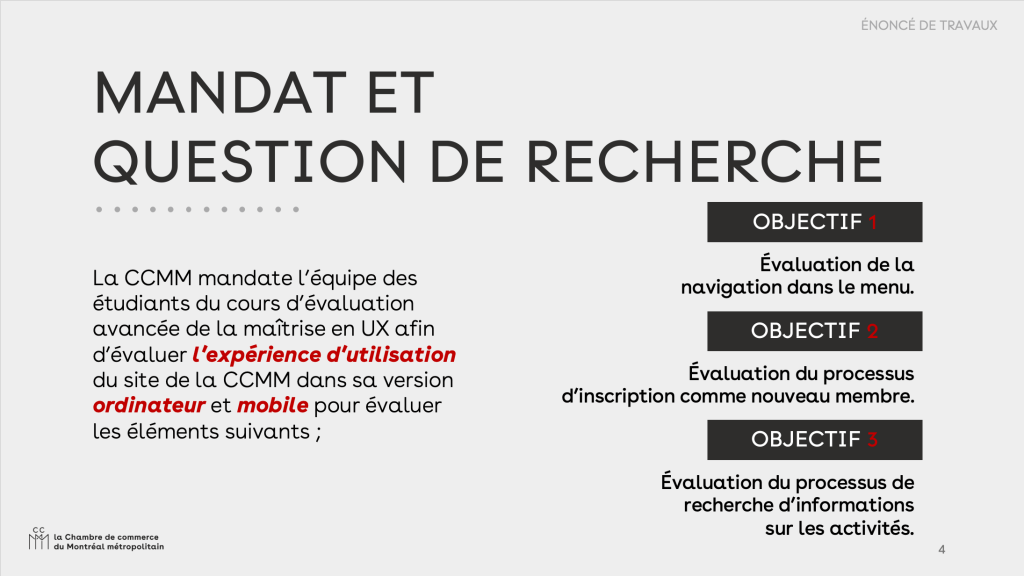
For this project, we decided to broaden the scope and evaluate both mobile and desktop version of the site. On top of testing the information architecture (finding specific pages, finding an event to sign up for), we also evaluated the new member sign-up process.
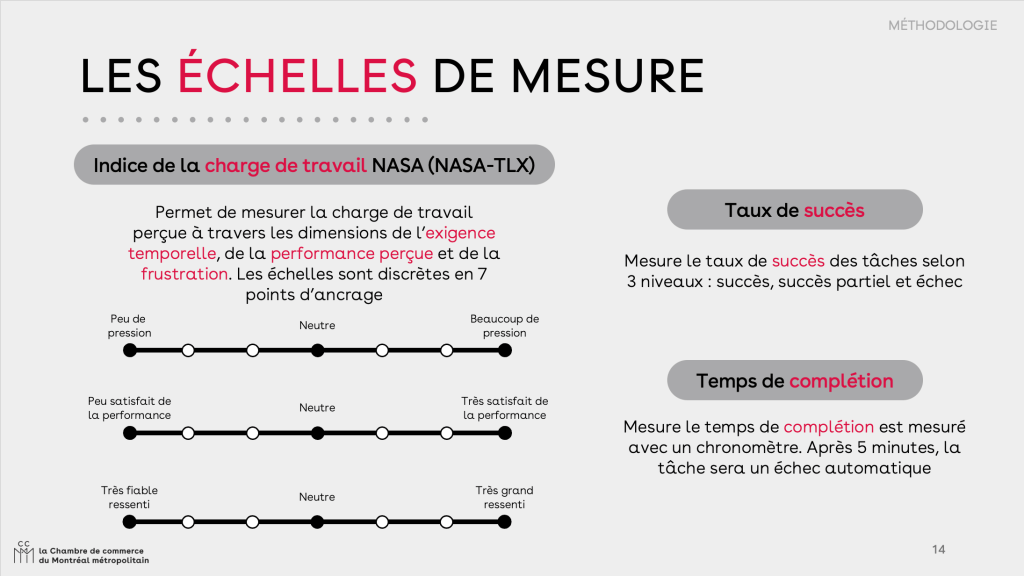
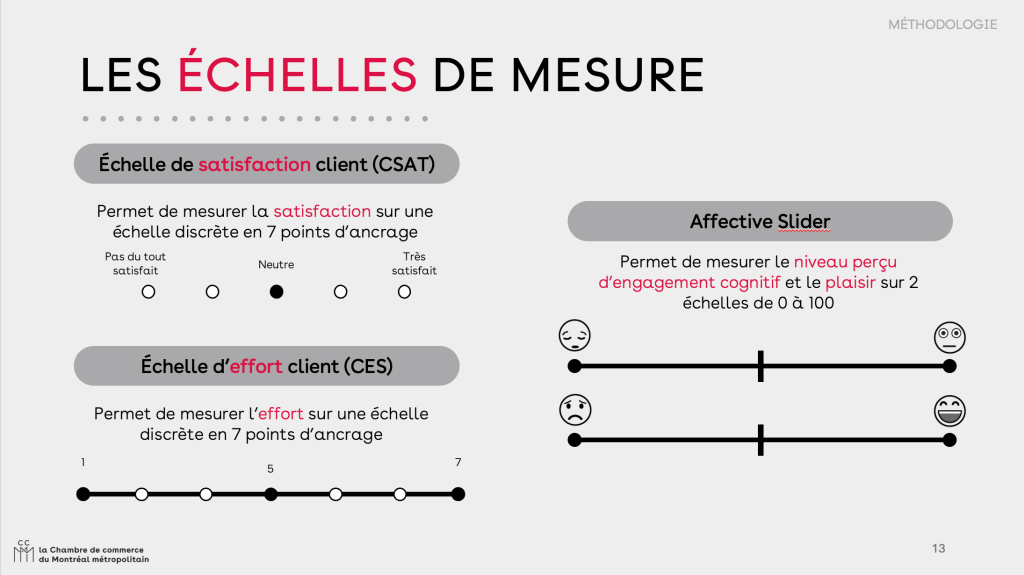
We used a battery of measures to get qualitative data, specifically task load, success rates, completion times, satisfaction, effort, and pleasure. To supplement the data, we also conducted post-test interviews for deeper insights.
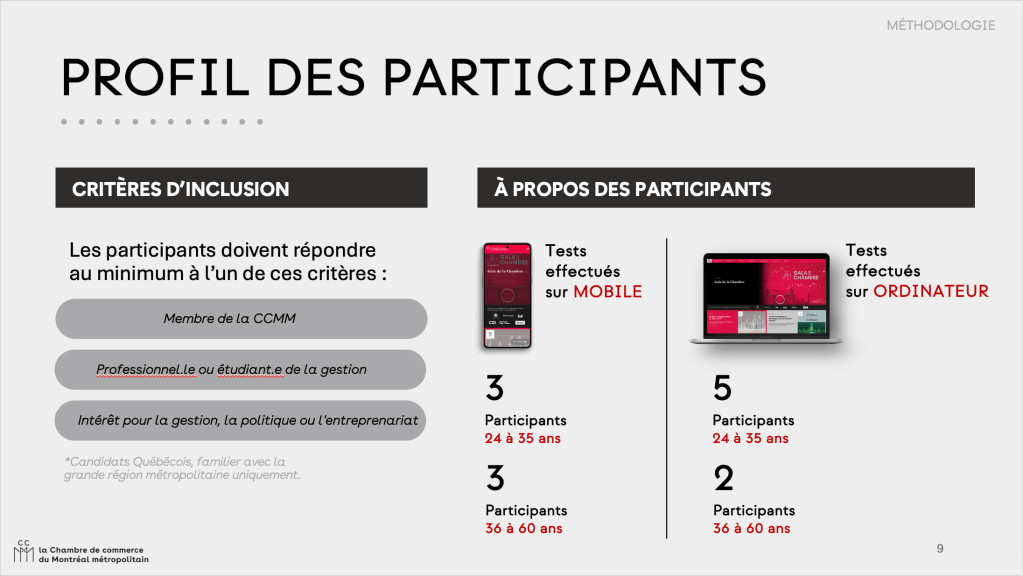
To capture the demographic of the CCMM, we broadened the inclusion criteria to include members, a professional or student in business, or anyone indicating an interest for business and entrepreneurship. We also limited the participants to only those who are familiar with the Greater Montréal region.
Despite the limited resources and time, we tried to get an even split of participants in the two age brackets (24-35 and 36-60) between the mobile and desktop versions.
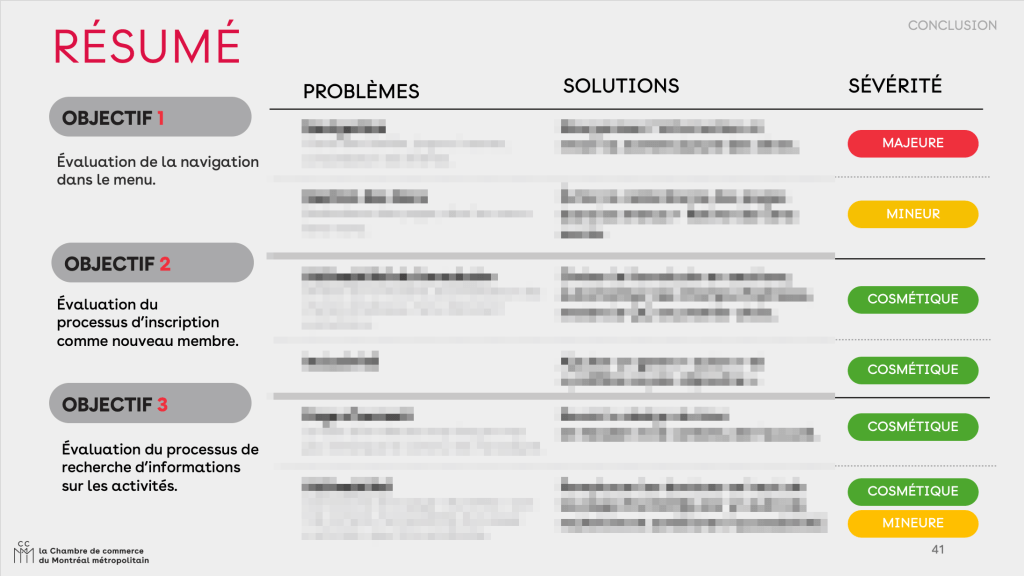
This time, rather than using a colour-coded thermometer, we rated the problems by severity based on a scale suggested by Nielsen. The scale ranged from mere cosmetic issues to critical ones, though no critical issues were identified. We also suggested solutions to address the problems, though nothing too specific was provided to allow the client flexibility in deciding how they should approach it.
 THOMAS YAP